Code review that runs on your Mac.
Bring your own provider. Your credentials stay in the Keychain; optional cross-Mac archives are end-to-end encrypted. It still greps the repo that calls you, the ticket, the errors and the flags before it judges.
No key to request
Your company won't give you an API key. PR Radar doesn't need one.
The AI writes code faster than anyone can review it - and it is still your name on the approval. Reviewing that flood should not begin with a losing fight against Security for a key you will never be handed.
- It drives Claude Code, not an API. PR Radar runs
claude -p- the same CLI you are already cleared to use. Your existing Claude Code or Kimi login is the entire setup. - Nothing new to get approved. No API key to request, no SDK to whitelist, no ticket with IT or Security. The access battle most engineers quietly lose never starts.
- Still yours to override. Prefer a raw API key, or an offline Ollama model that phones nobody? Both still work. Claude Code is simply the path that needs no permission.
Why the others miss it
A diff cannot answer the question
The bugs that reach production are rarely wrong inside the diff. They are wrong about something the diff does not contain.
- The caller in another repository. The signature changed, this repo compiles, and the service that calls it lives somewhere else.
- The requirement nobody checked. Clean, tested, reviewed - and not what the ticket asked for.
- The error it is already throwing. This exact path has been failing in production since Tuesday.
- The flag that is already on. "Behind a flag" is only reassuring until you check for whom.
- The fix that changes nothing. The override is gone and the diff reads like a fix - but the default it now falls back to, in a file this pull request never opens, is still the broken one.
Why not CodeRabbit?
Bot reviewers work for the repo. This one works for you.
CodeRabbit, Copilot review and the rest are bots on somebody else's server: they read each diff in isolation, on their machines, with your code. PR Radar is built the other way around.
- Reads the diff, alone
- Runs on their servers, with your code and their key
- Comments on every pull request, for everyone
- Priced per seat, per month
- Greps your whole organisation, mirrored locally - plus the ticket, errors, metrics and flags
- Runs on your Mac, on your own key; code and tokens never leave it
- Reviews what was asked of you, and posts only when you say
- Cents per review on your own API key, with a hard ceiling - or free with a local model
The reviewer
It investigates before it judges
Every pull request gets a Review button. A real agent reads the change, searches every mirrored repository in your organisation for whoever calls what changed, and follows the work into the ticket, your errors, metrics, flags and docs before it forms an opinion. The mirror is optional and downloads only when you agree; without one the agent still reviews from the diff and the file contents. Its search reaches as far as the mirror does, so the agent is told how much of your organisation it could search and asked to report a miss as none in those repositories, not none anywhere.
- Read-only by construction. Those fifteen tools are its entire reach. Fourteen only read; the fifteenth runs the change's own tests and scripts in a throwaway copy, inside a macOS sandbox with no network and no Keychain. Write and edit do not exist, and all of it is enforced by the tools, not requested in the prompt.
- Your stack, in the Keychain. Jira or Linear, Sentry or Datadog, Grafana, LaunchDarkly, AWS: paste a read token and that tool appears. Credentials live in the macOS Keychain and never reach a transcript.
- Claude, Kimi or local. Run it through Claude Code, Kimi or a local Ollama model that sends nothing to any provider. A review you start posts as you when it finishes unless you switch that off, and an approve verdict goes up as a real GitHub approval.
- It remembers across pushes. Review again after a fix and it knows what it flagged last time - so it tells you what you closed and what is still open, instead of handing you the same list rescored.
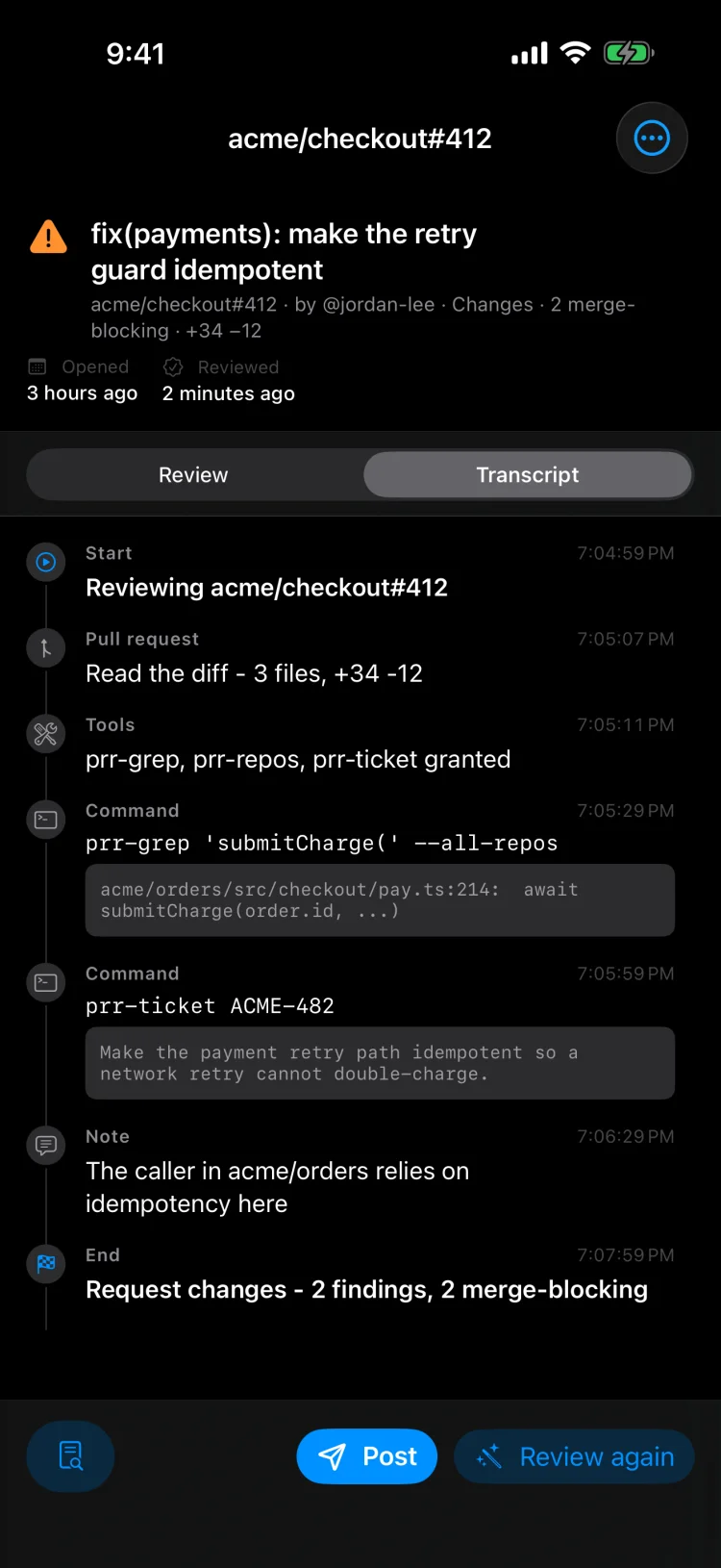

Yours, wherever you are
Done when you look. With you when you leave.
Automatic review watches what people ask of you by name - never the team firehose - and starts the moment the request lands. The queue you open is a queue of answers.
- Every moment, on your lock screen. Review requested, queued, reviewing, the one-word verdict, a colleague asking for another look - pushed as they happen, with the full review and transcript one tap away.
- Start, stop, post and argue - from your thumb. Dispatch a review, kill a runaway one, post a verdict behind its confirm, or open the chat that already holds the diff, the findings and the ticket. Export any of it as Markdown.
- Sealed end to end. Phone and Mac pair by camera and speak only to each other's keys. The relay between them carries ciphertext it cannot read, and Apple sees none of it either.
- Any pull request at all. Somebody pings you in Slack about a PR nobody assigned? Paste the link, from the menu bar or the phone.

What inference costs you
About a dollar, and a ceiling you set
What a review costs your provider on your own key - real numbers from the author's own ledger across dozens of reviews on a 200-repo organisation, not what we charge and not a projection.
- A ceiling per review, that you set. The engine stops the run the moment it is hit, not after the bill arrives. Conservative out of the box; raise it for the deep infra changes worth the dig.
- A rolling daily ceiling too. Set a cap over a rolling 24 hours; reaching it genuinely stops automatic review until it resets.
- Or nothing at all. Point it at a local model with Ollama: no token leaves your Mac, and nobody bills you.
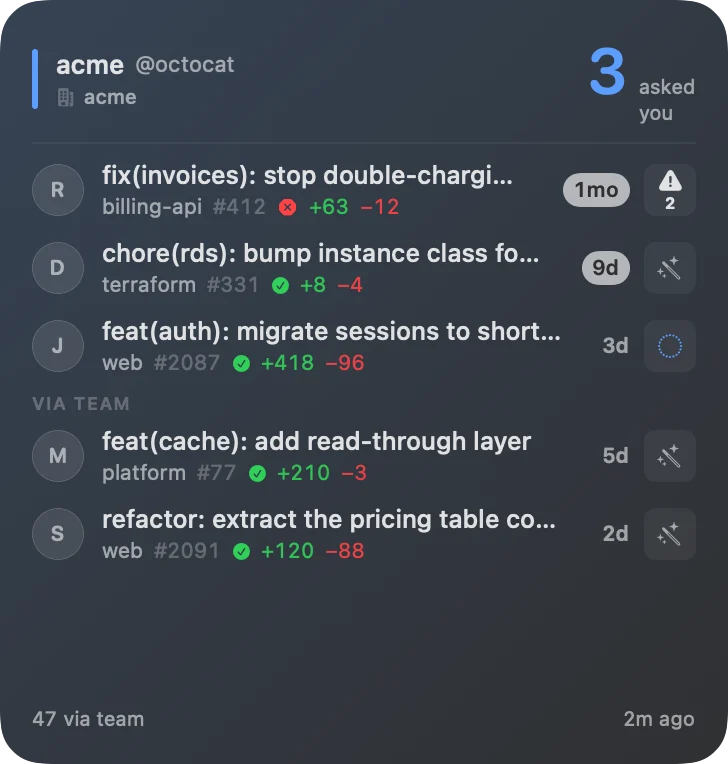
- Always visible. The widget carries what the last 24 hours cost, against the ceiling, on your desktop.
Your code, your keys
Everything runs on your Mac. Nothing runs on ours.
Reviews run on your machine with your credentials. Tokens live in the macOS Keychain. The reviewer's tools are read-only; the app posts, on your settings: a review you start posts as you when it finishes unless you switch that off, one PR Radar starts on its own posts only if you switch that on, and a re-review somebody asks for, which runs only once you turn on automatic review or re-review by comment, always posts. PR Radar writes its private state, transcripts and repository mirrors only to your Macs.
- Every run keeps receipts. The verdict, every finding, and the full transcript: every command, every refusal, every cent. Rereadable months later.
- Secrets are never recorded. Tools receive credentials as process environment; transcripts name keys, never values.
- You can read the prompt. Every instruction PR Radar sends is in Settings, in full, and you can edit it.
- The widget cannot leak. It ships with no network entitlement and is never handed a token: it draws a snapshot, and its Review button asks the app.
Pricing
Free to review. Join Pro when it opens.
Your spend cannot blow up. A hard ceiling per review and a daily ceiling per account, both yours, both enforced inside the run itself. Each commit is reviewed once - a rebase with identical changes carries its verdict for free - and only pull requests that asked you ever dispatch. The bill is boring by design.
The local reviewer is free forever. Pro will bring it off your desk - onto your phone, every Mac, and automatic review - and is opening by waitlist.
Local manual reviews. No account required.
- The full local reviewer: 15 read-only or sandboxed tools
- Cross-repo search across your whole org
- Claude, Kimi or a local model
- Review any PR by hand, on your Mac
- Multiple GitHub accounts, local history and transcripts
or $180 / yr - two months free
Everything, remote. Join the Pro waitlist - no card needed.
- Everything in Free, plus
- Reviews start themselves. A request lands, the review runs, the verdict is waiting before you look
- Your phone knows first. A push the moment a verdict or a blocker lands
- The iPhone app: read the whole review and talk to your reviewer, from anywhere
- The Lobby: a live page of your review station the whole team can watch
- All your Macs: live review status, history and transcripts over end-to-end encrypted device links
What you get, at a glance
Free is the complete reviewer on each Mac. Pro adds unattended work and one secure account across your devices.
| Capability | Free · $0 | Pro · planned $18/mo |
|---|---|---|
| Review on this Mac | ||
| Manual AI reviewsAny pull request, full verdict and findings | Included | Included |
| 15 read-only or sandboxed toolsCross-repo code, tickets, errors, metrics and flags, and running the change | Included | Included |
| ModelsClaude, Kimi, or local Ollama | Your provider | Your provider |
| GitHub accounts | Multiple | Multiple |
| History and transcripts | Stored locally | Local + encrypted sync |
| Automation and everywhere access | ||
| Automatic requested reviewsRuns unattended when someone asks you | Not included | Included |
| All your MacsLive running status, completed history and transcripts | Not included | Included |
| Offline account archiveEnd-to-end encrypted; PR Radar cannot read it | Not included | Included |
| iPhone app and push alerts | Not included | Included |
| Team LobbyRead-only live review dashboard | Not included | Included |
| Terms | ||
| PR Radar subscription | Free forever | $18 monthly or $180 yearly |
| Availability | Available now | Waitlist · no card |
| Model inferenceNo token markup from PR Radar | Not included | Not included |
Pro pricing is planned at $18 monthly or $180 yearly. Joining the waitlist does not start a trial, create a subscription, or charge you. When access opens, the subscription will pay for PR Radar's automation and remote features. Model inference is not included: reviews use your own provider account or local model, and PR Radar never marks up a token. Cross-Mac links are end-to-end encrypted, and Pro also keeps an end-to-end encrypted account archive so completed history remains available while the Mac that ran it is offline. PR Radar's service cannot decrypt that archive.
Get PR Radar
Two minutes to your first verdict
Drag to Applications, paste a GitHub token, and your queue is already being read. The next review request lands answered.
We send the macOS download link to your inbox, which is how we confirm the address is really yours.
1.13.4-a88e4c09